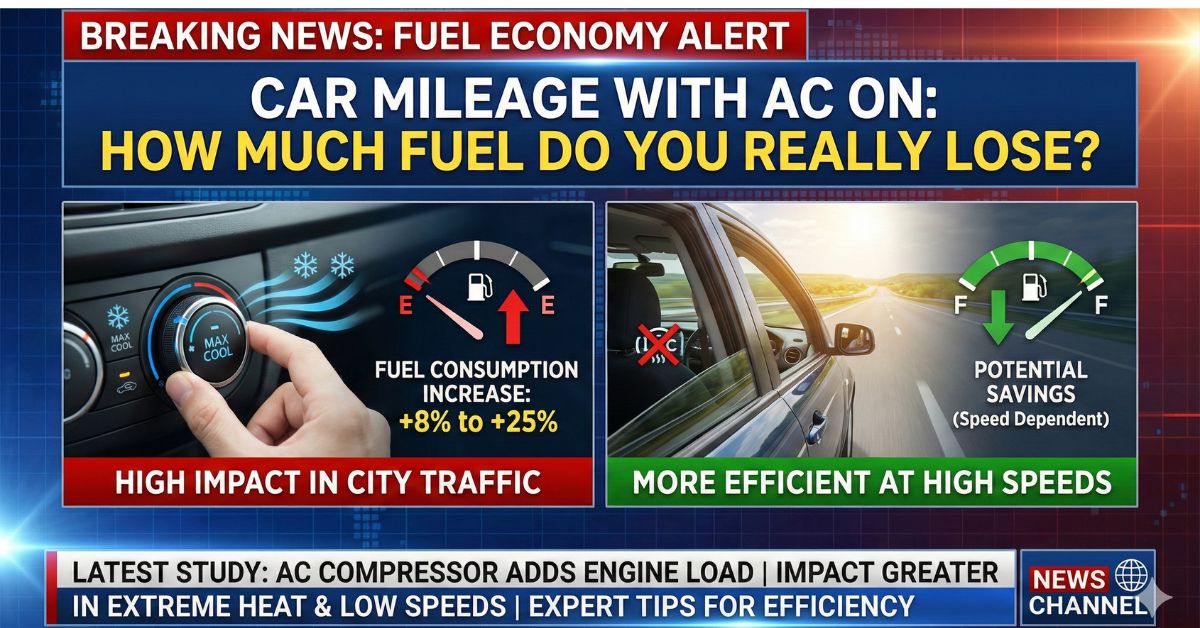
In India, you must have often heard this, friends. Usually, our elders say things like, “Turn off the AC, it increases expenses,” or “Switch off the car or bike at traffic signals, otherwise petrol will be wasted.” These kinds of arguments commonly happen in almost every household.
So let’s understand why this happens. We all try to save money in such situations, but the real question is—does turning off the AC actually make a difference, or is it just a myth?
So friends, the answer is yes, running the car’s AC does reduce mileage. However, how much mileage is affected depends on how you drive your vehicle. By understanding the science behind this, you can save more money without sweating unnecessarily.
And friends, I have personally tried this method myself. So why not adopt this approach and improve your savings too?
Why Does the AC Use Fuel?
Your car’s air conditioning system is not powered by the battery like the lights or music system. Instead, the AC compressor is connected directly to the engine by a belt. When you press the AC button, the compressor engages and puts an extra load on the engine.
Think of it like carrying a heavy backpack while running. You can still run, but you need more energy to maintain the same speed. Similarly, your engine burns more petrol or diesel to keep the car moving while simultaneously powering the cooling system.
How Much Mileage Do You Actually Lose?
In typical Indian driving conditions, keeping the car mileage with AC on can drop by anywhere from 5% to 20%. This wide range depends on several factors:
- Engine Size: Smaller engines (like 800cc to 1.2L hatchbacks) struggle more with the AC load compared to powerful SUVs. You might feel a noticeable drop in power (pickup) in small cars when the AC is running.
- Cabin Temperature: If you set the AC to the coldest setting (Low) on a hot 45-degree afternoon, the compressor works continuously, burning maximum fuel.
- Traffic Conditions: In bumper-to-bumper city traffic, your mileage drops significantly because the engine is burning fuel to run the AC even when the car is not moving (idling).
The “Windows Down” vs. “AC On” Debate
This is where most drivers get confused. Should you just roll down the windows to save fuel? The answer changes based on your speed.
In City Traffic (Below 70 km/h): When driving slowly in city areas, rolling down the windows is more fuel-efficient. The air resistance (drag) is low at these speeds, so the engine does not have to work hard to push the car forward. Turning off the AC and opening windows here can save you a good amount of fuel.
On Highways (Above 80 km/h): When you are speeding on a highway/expressway, the rules change. Rolling down windows creates a “parachute effect.” The air rushes inside the cabin and drags the car backward. The engine then has to burn more fuel to overcome this wind resistance than it would use to run the AC. Therefore, on highways, it is actually smarter and more efficient to keep the windows up and the AC on.
Smart Tips to Save Fuel With AC On
You do not have to suffer in the heat to save money. Use these expert tricks to get the best car mileage with AC on:
1. Use Recirculation Mode This is the most effective trick. Switch your AC to “Recirculation Mode” (the button with a car icon and a U-turn arrow inside). This cools the air already inside the cabin instead of constantly trying to cool hot air from outside. It reduces the load on the compressor significantly.
2. Don’t Blast it Immediately When you first enter a hot car, do not turn the AC to the max immediately. Roll down the windows for the first two minutes to let the trapped hot air escape. Once the hot air is out, roll up the windows and switch on the AC. This cools the car faster and uses less fuel.
3. Park in the Shade This sounds simple but has a huge impact. Parking under a tree or in a basement keeps the cabin temperature lower. A cooler cabin means your AC compressor works less to reach a comfortable temperature.
Conclusion: Comfort or Cost?
So friends, by now you must have understood when, where, and in which situations you should use the car’s AC or not. And it’s also true that running the AC does reduce mileage significantly.
I would also like to tell you that this type of AC cooling can be harmful to your health as well. Instead of this, you can choose a better option. During summers, while driving, you can keep your car windows open. If possible, you can also use the recirculation mode, which helps in saving more fuel.
By following these methods, you can maximize your savings and also enjoy natural air while driving.
Read More : How to Increase Bike Mileage
Frequently Asked Questions (FAQs)
1. Does the heater also consume fuel like the AC?
No, the heater works differently. It uses the waste heat generated by the engine to warm up the cabin. It does not put extra load on the engine like the AC compressor, so using the heater has almost zero impact on mileage.
2. Does AC consume fuel when the car is stopped?
Yes. If your engine is running and the AC is on, you are burning fuel even if the car is not moving. This is why mileage drops heavily in traffic jams.
3. Is it better to use Auto Climate Control?
Yes. If your car has Automatic Climate Control (ACC), use it. It automatically adjusts the fan speed and compressor usage to maintain the temperature efficiently, rather than running at full blast all the time.
4. Does AC affect CNG cars more?
CNG engines produce slightly less power than petrol engines. Since the AC draws power from the engine, you might feel a bigger drop in pickup/acceleration in a CNG car compared to a petrol or diesel car, especially on inclines.