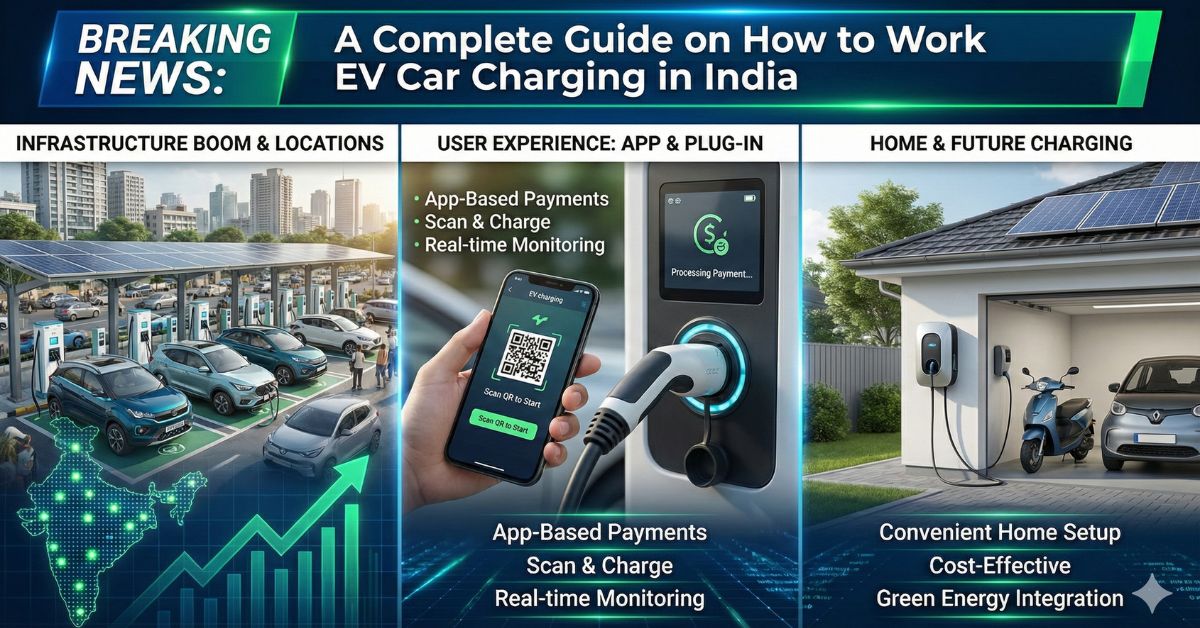
Electric vehicles are becoming a common sight on Indian roads. As petrol prices rise and the government aggressively promotes clean energy, more families are switching to battery-powered cars. However, many new buyers feel intimidated by the shift from fuel tanks to battery packs. If you are wondering how to work EV car charging at home or at public stations, you are not alone. This guide explains everything you need to know about charging an electric car in India, from understanding plug types to calculating the final cost.
Background: The Shift to Electric Vehicles in India
Over the last few years, the Indian automobile market has changed rapidly. Major car brands have launched affordable electric cars tailored for the Indian middle class. At the same time, companies are building thousands of public charging stations across the country. This rapid infrastructure growth means that electric cars are no longer restricted to short city commutes. You can now drive them on major highways with confidence. Understanding the charging ecosystem is essential for anyone planning to buy an electric vehicle today.
Key Details: How Electric Car Charging Actually Works
To understand the charging process, you first need to know the difference between the two main types of electricity used: Alternating Current (AC) and Direct Current (DC). Car batteries can only store power in DC format, but the electricity that comes from the national power grid is always AC.
When you plug your car into a standard home wall socket, the vehicle uses a small built-in converter to change the AC grid power into DC power before storing it in the battery. Because this onboard converter is small, the charging process is slow. This is known as slow AC charging and is best done overnight.
On the other hand, public fast-charging stations use massive external converters. These machines change the AC grid power into DC power before it even enters the car. This allows the electricity to bypass the car’s internal converter and flow straight into the battery. As a result, DC fast chargers can fill a car battery in a fraction of the time it takes at home.
Step-by-Step: Charging at a Public Station in India
Many drivers feel nervous the first time they visit a public charging station. However, learning how to operate these machines is quite simple. Most stations in India are unmanned and operate entirely through smartphone applications.
First, you need to download the mobile app of the charging provider, such as the Tata Power, Jio-bp, or ChargeZone app. Once you arrive at the station, open the app and scan the QR code printed on the machine. You then select the correct charging gun. In India, the CCS2 connector is the standard plug for almost all modern electric cars, making it easy to find a compatible station.
After securely plugging the heavy cable into your car, you use the mobile app to start the session. You can monitor the charging speed, battery percentage, and total cost directly on your phone screen. Once your battery reaches the desired level, you simply stop the session in the app, unplug the cable, and the money is automatically deducted from your linked digital wallet or UPI account.
Impact in India: The Cost of Charging
One of the biggest advantages of owning an electric vehicle is the incredibly low running cost. Charging an electric car is significantly cheaper than filling a petrol or diesel tank. If you charge your vehicle at home using a standard residential electricity connection, the cost is usually between six to ten rupees per unit of electricity. A full charge for a standard electric SUV at home might cost around three hundred rupees, giving you a driving range of nearly three hundred kilometers.
Read More : BMW iX3
Public fast chargers are more expensive because you are paying for the commercial infrastructure and high-speed convenience. Using a public DC fast charger typically costs between fifteen to twenty-four rupees per unit. Even at this higher commercial rate, driving an electric vehicle remains much more affordable per kilometer than driving a traditional combustion engine car.
Official Updates and What Happens Next
The Indian government is heavily supporting the expansion of electric mobility. Through fresh initiatives like the PM E-DRIVE scheme, the government has allocated massive funds to install thousands of public chargers across highways and Tier-II cities. Additionally, recent guidelines from the Ministry of Power have made it easier for private companies and residential housing societies to install charging points without needing a commercial electricity license.
Looking ahead to 2026 and beyond, industry experts predict that EV charging stations will become as common as traditional fuel pumps. We will see more solar-integrated charging hubs and ultra-fast chargers capable of giving a car hundreds of kilometers of range during a quick coffee break.
Frequently Asked Questions
Can I charge my electric car safely in the rain?
Yes, it is completely safe to charge an electric vehicle while it is raining. Both the electric car and the charging equipment are designed to be strictly weatherproof and highly insulated to prevent any water damage or electric shocks.
Should I charge my car battery to a full hundred percent every day?
It is generally recommended to keep your daily charge between twenty and eighty percent. Charging to a full hundred percent every single day can put stress on the battery cells and reduce the overall lifespan of the pack over the years. It is best to save the full hundred percent charge for long intercity trips.
Can I plug my electric car into a normal home socket?
Yes, you can use a standard fifteen-ampere home wall socket to charge your vehicle. However, this is the slowest method available and can take up to fifteen hours for a complete charge. Installing a dedicated home wallbox charger provided by the car manufacturer is a much faster and safer everyday option.
How long does it actually take to charge at a public fast station?
Using a commercial DC fast charger, most modern electric cars in India can go from twenty percent to eighty percent battery capacity in about forty-five to sixty minutes. The exact time depends heavily on your car’s battery size and the specific power output of the charging machine.