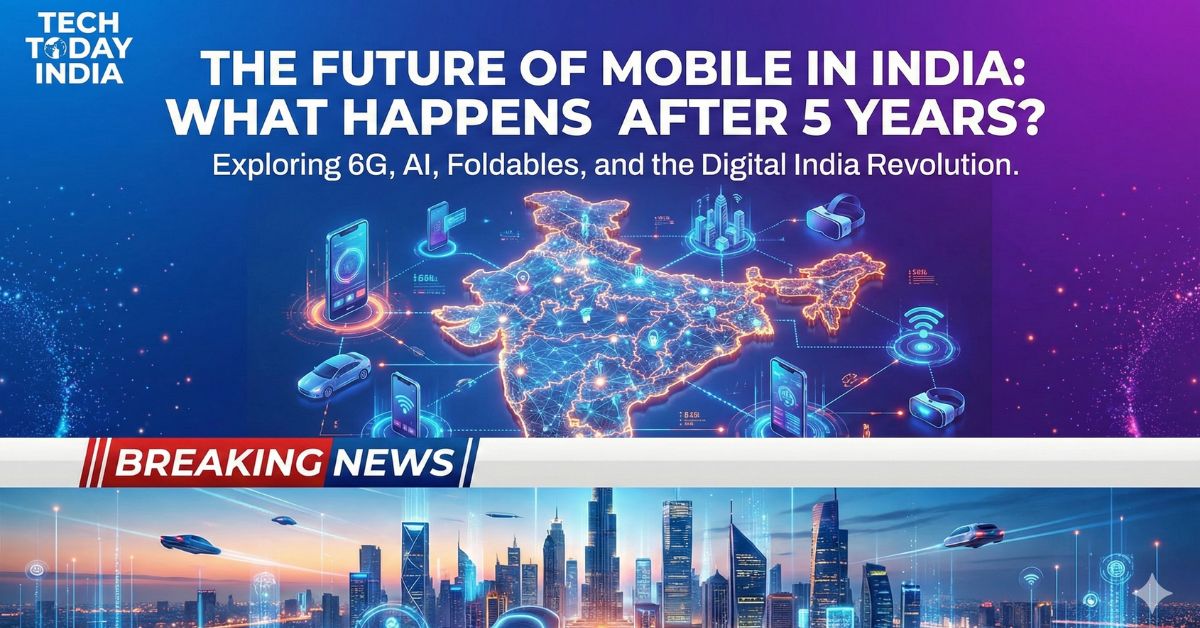
Imagine a world where you don’t carry a phone in your pocket. No scrolling, no tapping on glass, no charging a brick every night. According to some of the biggest names in tech, this future isn’t just a sci-fi dream—it is the plan for the next decade.
Recently, bold predictions from tech leaders like Elon Musk and Nokia’s CEO have sparked a massive debate: Will smartphones really become extinct in the next 5 years?
For Indian users, who are just settling into the 5G era, this sounds confusing. Are we moving towards brain chips and smart glasses, or will the trusty mobile screen stay with us? This article breaks down the reality, the hype, and what the next 5 years actually look like for the Indian smartphone market.
The Big Prediction: Why Experts Say “The Phone is Dead”
The buzz started when Elon Musk, CEO of Tesla and SpaceX, predicted that traditional smartphones and apps would vanish within 5 to 6 years. His vision? A future where devices are just “AI edge nodes”—screens that generate what you want to see in real-time using Artificial Intelligence, without standard apps. Even more radical is his push for Neuralink, a brain chip that could eventually allow us to communicate telepathically, bypassing screens entirely.
He isn’t alone. Nokia’s CEO, Pekka Lundmark, famously stated that by 2030, the smartphone as we know it “will not be the most common interface.” He believes that with the arrival of 6G networks, technology will move directly into our bodies (implants) or onto our faces (smart glasses).
Meta (Facebook) is also betting billions on smart glasses replacing phones by the 2030s, creating a world where digital info floats in front of your eyes.
The Reality Check: What Will Actually Happen in India?
While billionaires dream of brain chips, the ground reality in India is different. Smartphones are not disappearing in 5 years. In fact, they are becoming more important than ever. Here is what is actually changing.
1. The “Super-Cycle” of 5 Years
In the past, Indians changed phones every 2 years. Now, that gap is widening. Because phones are getting expensive and hardware isn’t changing much (a 100MP camera isn’t that different from a 50MP one for most users), people are holding onto their devices for 4 to 5 years.
- Trend: You will buy fewer phones, but you will pay more for them.
- Result: The “Budget Phone” category under ₹10,000 is shrinking, while the “Premium” category is booming.
2. AI Will Kill “Apps”, Not Phones
The biggest shift coming to your phone isn’t the screen—it’s the software. Currently, if you want to book a cab, order food, and check the weather, you open three different apps.
- The Future: “Agentic AI” will take over. You will simply tell your phone, “Book a ride to Connaught Place and order a pizza to arrive when I get home.”
- Impact: The phone becomes a smart assistant. You won’t hunt for icons; the AI will do the work in the background.
3. The Rise of “Companion” Devices
Instead of the phone vanishing, it will become a “Hub.” You might keep the phone in your bag while you use Smart Glasses or a Smartwatch for quick tasks.
- Scenario: You get a WhatsApp message. Instead of pulling out your phone, you read it on your glasses or hear it via earbuds and reply by voice. The heavy processing still happens on the phone in your pocket, but you look at it less.
The Indian Market: 1 Billion Users and Counting
Far from dying, the Indian smartphone market is projected to hit 1 billion users by 2026.
- 5G is the Standard: By next year, nearly 80% of new devices sold in India will be 5G-ready.
- Offline is King: Interestingly, after years of online sales dominance (Flipkart/Amazon), Indian buyers are returning to offline shops. People want to touch and feel these expensive devices before buying.
- Local Brands: Companies like Lava are trying to make a comeback using clean software and AI features, challenging Chinese giants like Vivo and Xiaomi.
What About 6G?
6G is the next big milestone, expected around 2030. This is the technology Nokia believes will end the smartphone era. 6G will be lightning-fast and could enable the “Internet of Senses”—where you can potentially “feel” or “smell” digital environments. However, for the average Indian user, mass adoption of 6G is still at least 7–8 years away.
Verdict: Should You Worry?
No. Your smartphone is safe. For the next 5 years (until 2030), the rectangular slab of glass will remain your primary device. However, it will get smarter, more expensive, and less dependent on you tapping apps. The “death” of the smartphone will be a slow fade, not a sudden vanish. We will slowly transition to glasses and wearables, but for now, the screen stays in your pocket.
FAQs: Future of Smartphones
1. Will I need a brain chip to use the internet in 2030?
No. While technology like Neuralink is being tested, it is currently for medical purposes (helping paralyzed people). Mass consumer brain chips are decades away, not 5 years away.
2. Is 5G enough, or should I wait for 6G?
5G is more than enough for current needs. 6G is expected to launch commercially around 2030. You do not need to worry about it for your next phone purchase.
3. Are smartphones getting more expensive in India?
Yes. Components like memory and chips are becoming costlier. Also, brands are focusing on “Premium” phones because they last longer.
4. Will mobile apps really disappear?
They won’t disappear, but they will become less visible. AI will likely handle the tasks inside the apps so you don’t have to open them manually as often.
5. What will replace the smartphone eventually?
Most experts agree that Augmented Reality (AR) Smart Glasses have the best chance of replacing phones. They allow you to see digital screens in the real world without looking down at your hand.