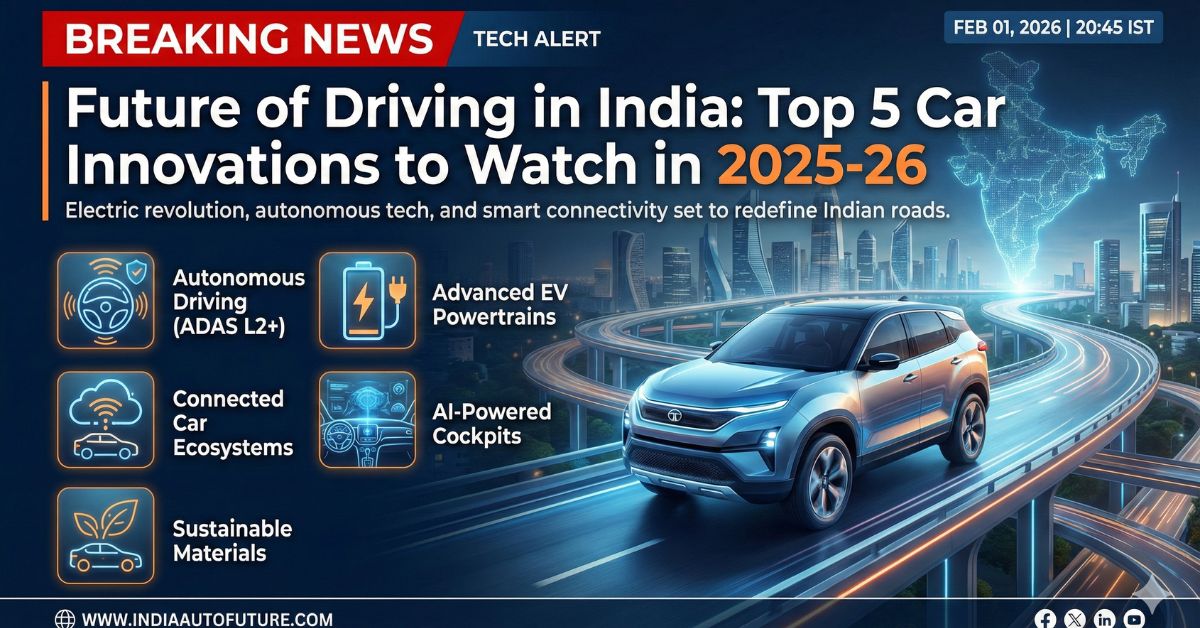
For decades, the Indian car buyer asked only one question: “Kitna deti hai?” (How much mileage does it give?). But in 2025, that conversation has completely changed. Today, Indian roads are witnessing a massive tech transformation. We are moving from simple fuel-efficient cars to smart, connected, and super-safe machines.
From the grand showcase at the Bharat Mobility Global Expo 2025 to the implementation of new government safety norms, the auto sector is innovating at lightning speed. Whether you are a car enthusiast or a regular buyer, here is everything you need to know about the latest innovations driving India forward.
1. The Electric Revolution: From Niche to Mainstream
For a long time, Electric Vehicles (EVs) were seen as expensive toys for city use. In 2025 and 2026, that narrative is flipping. The biggest innovation isn’t just “batteries”—it is affordability and range.
- The Maruti Factor: The highly anticipated Maruti Suzuki e-VITARA is set to be a game-changer. When India’s largest carmaker enters the EV space, it signals that electric cars are ready for the mass market.
- Battery Tech: Companies are moving towards safer, energy-dense batteries that offer 400+ km of real-world range.
- Charging Ecosystem: Under the new PM E-DRIVE scheme (which replaces the old FAME subsidies), the government is aggressively funding charging stations. The focus has shifted from just subsidizing the car to fixing the “range anxiety” by installing thousands of chargers across highways.
2. Flex-Fuel Technology: The Practical Alternative
While the world rushes toward electric, India is betting big on a “middle path” called Flex-Fuel. This was the star of the Bharat Mobility Expo 2025.
What is it? Flex-fuel vehicles (FFVs) come with modified engines that can run on a blend of petrol and ethanol (up to 85% ethanol).
- Why it matters: Ethanol is made from sugarcane and maize, which helps Indian farmers and reduces our oil import bill.
- Key Models: Major players like Hyundai (with the Creta Flex-Fuel), Tata Motors (with the Punch Flex-Fuel), and Mahindra (with the XUV 3XO Flex-Fuel) have showcased production-ready models.
- The Benefit: Ethanol is cheaper than pure petrol. If your car can run on E85 fuel, your running cost per kilometer drops significantly without needing to buy an expensive EV.
3. Bharat NCAP & The Rise of ADAS
Safety is no longer optional. In the past, “safety features” meant seatbelts. Now, it means active technology that prevents accidents before they happen.
Bharat NCAP (New Car Assessment Programme): India finally has its own crash-testing agency. Cars sold in India are now tested specifically for Indian road conditions and given a “Star Rating” locally. This forces manufacturers to build stronger cars to avoid getting a “zero-star” shame tag.
ADAS (Advanced Driver Assistance Systems): Once limited to ₹50 lakh+ luxury cars, ADAS is now appearing in cars costing under ₹15 lakh.
- How it works: It uses cameras and radars to “see” the road.
- Features: It can automatically apply brakes if a pedestrian jumps out (Auto Emergency Braking), keep you in your lane (Lane Keep Assist), and maintain a safe gap on highways (Adaptive Cruise Control).
- Impact: By 2026, experts predict ADAS will be a standard feature in most top-end variants of compact SUVs.
4. The “Software-Defined Vehicle” (SDV)
Cars are becoming smartphones on wheels. The mechanical engine is still there, but the software controls the experience.
- OTA Updates: Just like your phone gets an Android or iOS update, modern cars now receive “Over-the-Air” (OTA) updates. A car bought in 2025 can get a software update in 2026 that improves its battery range or adds a new voice command feature.
- Connected Tech: With 5G integration, cars can “talk” to each other (V2V communication) to warn about traffic jams or accidents ahead. This is a huge step toward reducing congestion in metro cities like Delhi, Mumbai, and Bengaluru.
5. What Happens Next? (The 2026 Outlook)
As we look towards 2026, the Indian market will see a “war of powertrains.”
- Hybrids vs. EVs: While the government pushes for EVs, hybrid cars (which use both petrol and a small battery) are seeing huge demand because they offer high mileage (25+ kmpl) without the need to charge.
- Hydrogen Future: Commercial vehicles like trucks and buses are testing Hydrogen Fuel Cells. This is still in the pilot stage but is crucial for long-distance transport where batteries are too heavy.
Frequently Asked Questions (FAQs)
Q1: What is the main benefit of Flex-Fuel cars?
A: Flex-fuel cars can run on a mix of petrol and ethanol. Since ethanol is cheaper and produced locally in India, it reduces fuel costs and pollution compared to running on 100% petrol.
Q2: Is ADAS useful on chaotic Indian roads?
A: Yes, but with caution. Features like “Blind Spot Monitoring” and “Rear Cross Traffic Alert” are very useful in India. However, features like “Lane Keep Assist” might be tricky on roads without proper lane markings.
Q3: Will electric cars become cheaper in 2026?
A: Yes. As battery prices fall and local manufacturing increases (with companies like Tata and Maruti making batteries in India), the upfront cost of EVs is expected to come down.
Q4: What is the PM E-DRIVE scheme?
A: It is a government scheme that provides financial support to promote electric mobility. It focuses on subsidizing electric two-wheelers, three-wheelers, buses, and setting up charging stations.
Q5: Is Bharat NCAP mandatory for all cars?
A: Currently, it is voluntary for car manufacturers to send their cars for testing. However, market pressure means most brands will want a 5-star rating to attract buyers.