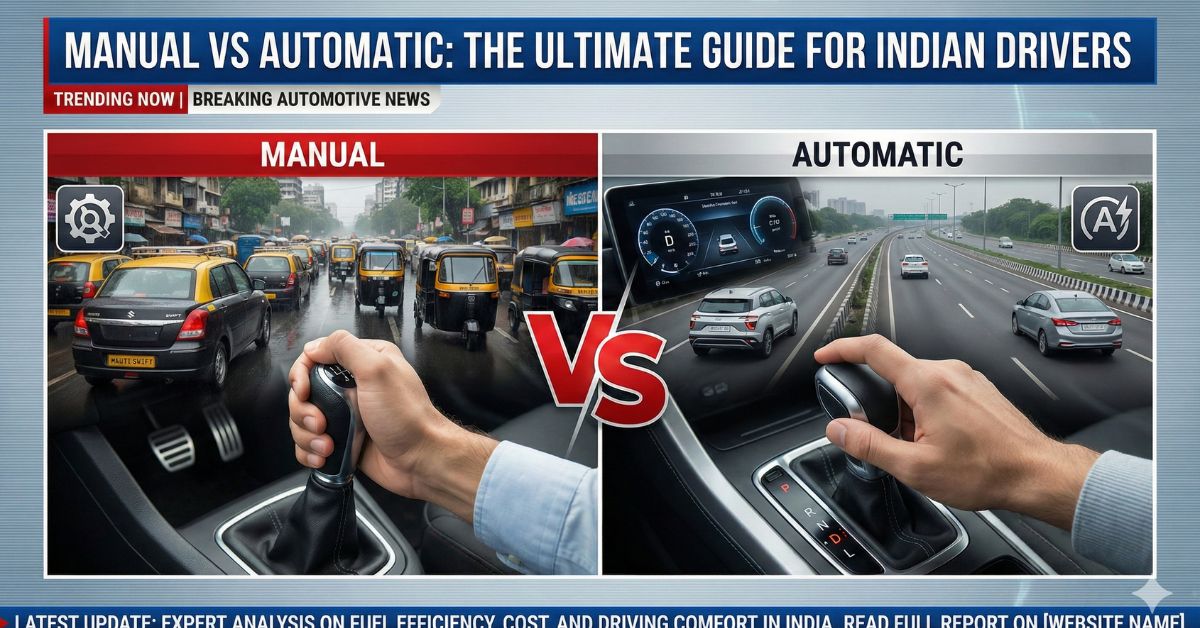
Buying a new car in India is no longer just about choosing the brand or color. The biggest confusion for buyers today is choosing the gear system: Automatic or Manual?
A few years ago, the answer was simple. People bought manual cars because they were cheaper and gave better mileage. But in 2025, things have changed completely. With traffic jams increasing in cities like Delhi, Mumbai, and Bangalore, the demand for automatic cars has skyrocketed.
Are you confused between the two? This guide compares Automatic vs Manual cars in India based on price, mileage, maintenance, and driving comfort to help you decide.
1. The Shift: Why Are Indians Choosing Automatics?
For decades, India was a “manual-only” market. Drivers felt that manual gears gave them better control. However, the situation has flipped.
- Traffic is the main reason: Driving a manual car in bumper-to-bumper traffic requires you to press the clutch hundreds of times. This causes “clutch fatigue” and leg pain.
- Technology is better: Old automatic cars were slow and consumed a lot of petrol. Modern automatics (like AMT, CVT, and DCT) are smooth and fast.
- Affordability: Earlier, only luxury cars were automatic. Now, even budget cars like the Maruti Alto K10, Tata Tiago, and Renault Kwid have automatic options.
2. Manual Transmission (MT)
In a manual car, the driver uses a clutch pedal and a gear stick to change gears.
Pros (Advantages)
- Lower Price: Manual cars are usually ₹60,000 to ₹1.2 lakh cheaper than automatic versions.
- Low Maintenance: Repairing a manual gearbox is simple and cheap. Clutch replacements cost far less than automatic repairs.
- Driver Control: You have full control over the car’s power. This is great for overtaking on highways or driving on hills.
- Mileage: In expert hands, manual cars often deliver slightly better mileage.
Cons (Disadvantages)
- Difficult in Traffic: Constant gear shifting in city traffic is tiring and stressful.
- Hard to Learn: New drivers often struggle with the “clutch-release” timing, leading to engine stalling.
3. Automatic Transmission (AT)
In an automatic car, the car changes gears for you. There is no clutch pedal—only a brake and an accelerator.
Pros (Advantages)
- Stress-Free Driving: This is the biggest benefit. In heavy traffic, you just press the brake and accelerator. Your left leg rests completely.
- Easy to Learn: Beginners can learn to drive an automatic car very quickly because there is no fear of the engine stalling.
- Better Resale Value in Cities: In metro cities, used car buyers now prefer automatics.
Cons (Disadvantages)
- Higher Price: You have to pay an extra premium upfront.
- Maintenance Cost: If an automatic gearbox fails (which is rare but possible), the repair bill can be very high compared to a manual one.
Types of Automatics in India:
- AMT (Automated Manual Transmission): Cheapest automatic. Found in Maruti and Tata cars. Slightly jerky but high mileage.
- CVT (Continuously Variable Transmission): Very smooth. Best for city driving (e.g., Honda City, Nissan Magnite).
- Torque Converter (TC): Reliable and smooth. Found in SUVs like Creta and Scorpio-N.
- DCT/DSG (Dual Clutch): Very fast gear shifts. Fun to drive but can be expensive to maintain (e.g., Hyundai Venue, Volkswagen).
4. Key Comparison: The Final Verdict
| Feature | Manual Car | Automatic Car |
| Price | Cheaper | Expensive (₹60k – ₹1.5L extra) |
| Mileage | High (Driver dependent) | Nearly equal to Manual (especially AMTs) |
| Traffic Comfort | Poor (High fatigue) | Excellent (Stress-free) |
| Maintenance | Low Cost | Medium to High Cost |
| Highway Driving | Fun & Engaging | Easy & Relaxed |
5. Which One Should You Buy?
Choose a Manual Car if:
- You have a tight budget.
- You drive mostly on highways or open roads with less traffic.
- You are a driving enthusiast who loves controlling the gears.
- You live in a rural area or small town where traffic is light.
Choose an Automatic Car if:
- You live in a metro city (Delhi, Bangalore, Mumbai, etc.) with heavy traffic.
- You commute daily to the office in peak hours.
- You are a new driver or lack confidence with a clutch.
- Family members (like elderly parents) will also drive the car.
Expert Tip: If you want an automatic but are worried about mileage, look for AMT cars. They offer mileage almost identical to manual cars.
Read More : Car Silencer Noise Problem
Frequently Asked Questions (FAQs)
Q1: Does an automatic car give less mileage than a manual?
Historically, yes. However, modern AMT cars give almost the same mileage as manual cars. Other types like Torque Converters may give 1-2 km/l less, but the gap is closing fast.
Q2: Is it expensive to maintain an automatic car?
Routine service costs are similar. However, if the automatic gearbox gets damaged, repairs are much more expensive than replacing a manual clutch plate.
Q3: Which automatic is best for city traffic in India?
For pure city comfort, CVT is the best because it is very smooth. For budget buyers, AMT is the best choice.
Q4: Do automatic cars have good resale value?
Yes. In big cities, the demand for second-hand automatic cars is very high, so you will likely get a good price when you sell it.
Q5: Can I drive an automatic car on hills?
Yes. Modern automatic cars come with “Hill Hold Assist” which prevents the car from rolling back on slopes. They perform very well on hills.