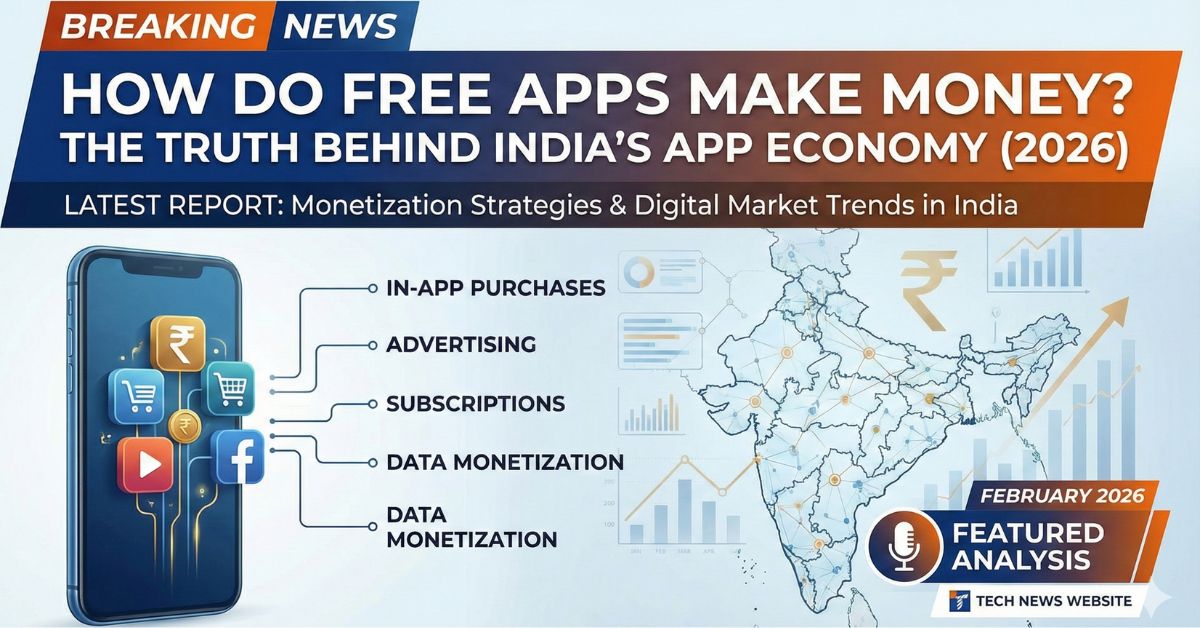
Are free apps really free? From hidden data tracking to the recent Google-Apple antitrust battles in India, here is the complete truth behind the “Free App” economy.
Millions of Indians wake up every day and use WhatsApp, YouTube, UPI payment apps, and casual games without paying a single rupee. It feels like a great deal. But in the tech world, there is a famous saying: “If you are not paying for the product, you are the product.”
Recently, this topic has grabbed headlines in India. The Competition Commission of India (CCI) has issued strict warnings to tech giants like Google and Apple regarding their app store policies, while the new Digital Personal Data Protection (DPDP) Rules 2025 are forcing companies to change how they handle your “free” data.
This article explains exactly how free apps make money, why it matters for Indian users, and the hidden costs you might not see on your screen.
The Big News: Why Everyone is Talking About App Business Models
In early 2026, the debate over app monetization in India heated up. Here is what has happened recently:
- CCI vs. Tech Giants: The Competition Commission of India (CCI) has cracked down on Apple and Google. The core issue? These companies charge high commissions (up to 30%) on digital purchases made inside apps. Indian startups have protested, leading to antitrust investigations.
- Privacy Backlash: The Indian government recently had to withdraw a mandate for a “cyber safety” app after experts raised alarms about privacy and surveillance. This has made Indian users more aware of what permissions they grant to free apps.
- The Rise of “Mini Apps”: To bypass high fees and keep apps “light” for Indian budget phones, developers are shifting to “mini apps” (small apps inside larger ones like payment or chat apps).
How Do Free Apps Actually Make Money?
Developers need to pay for servers, staff, and technology. If they don’t charge you a download fee, they use one of these four proven business models.
1. The Freemium Model (Try Before You Buy)
This is the most popular model in India. The app is free to download, and basic features are free forever. However, if you want “extra” powers, you must pay.
- How it works: You play a game for free, but buying a special skin or weapon costs money. Or, you use a cloud storage app for free up to 5GB, but pay for 100GB.
- Indian Context: Music apps like Spotify or JioSaavn offer free music with ads, but charge a monthly fee for ad-free listening and offline downloads.
2. In-App Advertising (Selling Your Attention)
This is the classic TV model applied to phones. The app is completely free, but you are forced to watch ads.
- Banner Ads: Small strips of ads at the bottom of the screen.
- Video Ads: You must watch a 30-second video to get an extra “life” in a game or to continue watching a show.
- Why it works: Advertisers pay the app developer every time you view or click an ad. With India’s massive population, even small payments per user add up to crores of rupees.
3. Data Monetization (The Hidden Economy)
This is the most controversial model. Some apps collect your location history, spending habits, and device details. They sell this data to third-party marketing companies, hedge funds, or researchers.
- The Risk: Often, users do not read the “Terms and Conditions” and unknowingly agree to share their data.
- Regulation: India’s new DPDP Act aims to stop this by requiring companies to ask for clear, specific consent before tracking you.
4. Affiliate and Referral Fees
Have you ever seen a free finance app suggesting you “Apply for this Credit Card”? If you click that link and get the card, the app gets a commission.
- Example: Many UPI and wallet apps in India allow you to pay bills for free but make money when you buy insurance or gold through their platform.
The “Hybrid” Future: What Changes in 2026?
The simple days of just “ads” or “paid” are ending. In 2026, experts are seeing a shift toward Hybrid Monetization.
- AI Subscriptions: Free photo apps now offer basic filters for free but charge for advanced AI editing tools.
- Micro-Transactions: Instead of a big monthly subscription, apps are asking for tiny payments (e.g., ₹10 or ₹20) for specific items or day passes. This “sachet pricing” works very well in the price-sensitive Indian market.
Why This Matters to You (The Risks)
While free apps are convenient, Indian users need to be cautious about two things:
- Privacy Leaks: Free apps often ask for permissions they don’t need (like a flashlight app asking for your contact list). This data can be used for spam calls or scams.
- Battery and Data Drain: Apps heavy with ads consume more of your mobile data and battery life than paid apps, which “costs” you money in the long run.
Official Safety Tip
Note: Always check the “App Permissions” section in the Google Play Store or Apple App Store before downloading. If a simple calculator app wants access to your SMS or Camera, avoid it.
What Happens Next?
The landscape for free apps in India is changing fast.
- Stricter Laws: The Indian government is tightening rules on “Dark Patterns”—tricks that websites use to make you buy things or give up data unintentionally.
- More Local Apps: With the government pushing for an “Atmanirbhar” (self-reliant) digital ecosystem, we may see an Indian-specific app store that offers fairer terms to developers, potentially reducing the number of ad-heavy spam apps.
Read More : Inside Google Play Store
Frequently Asked Questions (FAQs)
Q1: Is it safe to use free apps that have ads?
Yes, most legitimate apps with ads are safe. However, avoid clicking on ads that promise “free money” or look suspicious. Always download apps from the official Play Store or App Store.
Q2: Can free apps steal my money?
A free app cannot take money from your bank unless you authorise a payment. However, some fraudulent apps might trick you into signing up for a subscription. Always check your bank statements.
Q3: Why do some free apps ask for my location?
Some apps need it (like maps or food delivery). Others collect it to sell to advertisers so they can show you local ads. You can deny location access to apps that don’t need it.
Q4: What is the ‘Freemium’ model?
It combines “Free” and “Premium.” You get the basic service for free, but you must pay to unlock advanced features or remove ads.
Q5: How do messaging apps like WhatsApp make money if they are free?
WhatsApp makes money through “WhatsApp Business,” where companies pay to communicate with customers. They do not show ads in your personal chats.