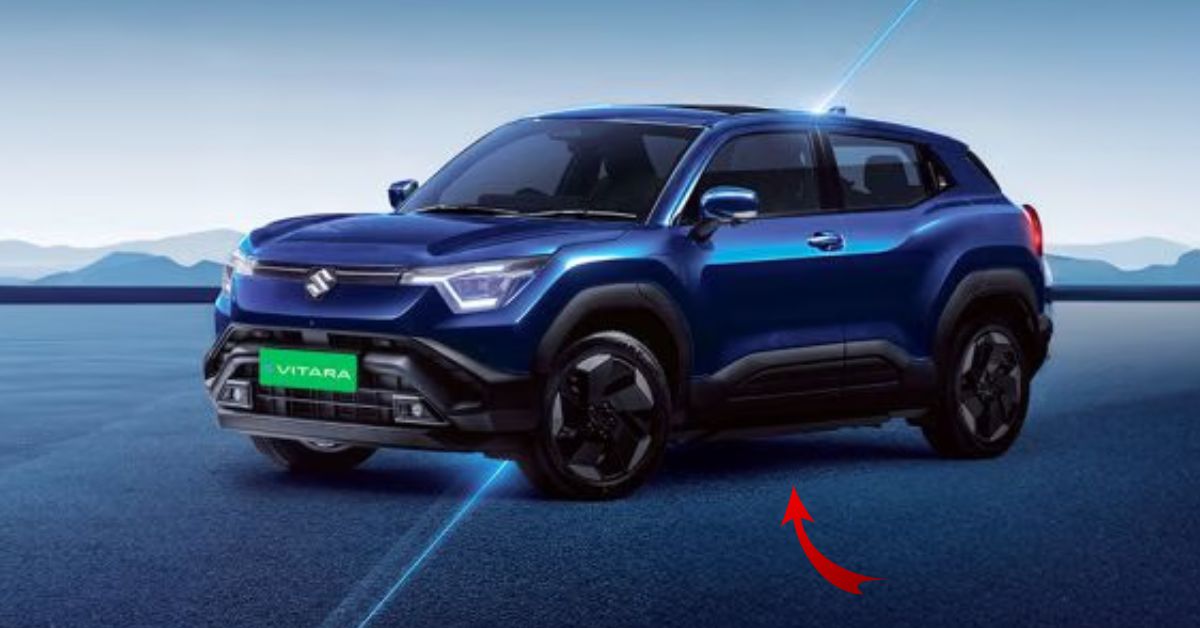
For decades, Maruti Suzuki has been synonymous with affordable, reliable, and mass-market mobility in India. The introduction of the Maruti Suzuki e-Vitara in late 2025 marks the company’s decisive entry into the long-range electric vehicle (EV) segment. Built on a dedicated EV architecture, this mid-size electric SUV is not merely an electrified version of an existing model; it is a globally benchmarked product designed from the ground up to challenge the status quo, aiming to redefine customer expectations in terms of range, safety, and technology.
Unveiled at the Bharat Mobility Global Expo 2025, the e-Vitara is a pivotal model, promising to leverage Maruti’s immense service network and competitive pricing strategy. This comprehensive review breaks down the platform, battery technology, performance, cutting-edge features, and the expected price range of this highly anticipated new EV.
Platform, Safety, and Design Philosophy
The e-Vitara is underpinned by a new foundation that promises global-standard rigidity and safety, essential for a modern EV.
A. The HEARTECT-e Dedicated EV Platform
The e-Vitara is built on the HEARTECT-e platform, an evolved version of Suzuki’s successful HEARTECT architecture, purpose-built for electrification.
- Structural Integrity: The platform features reinforced structures and an energy-absorbing battery pack mounting design, contributing to exceptional structural rigidity.
- Safety Rating: This robust engineering has paid off: the e-Vitara has secured a perfect 5-star safety rating in the rigorous Bharat NCAP crash tests, making it one of the safest vehicles in its segment and a significant milestone for Maruti Suzuki.
- Dimensions: With an overall length of 4,275 mm and a long wheelbase of 2,700 mm, the e-Vitara offers superior cabin space and stable dynamics compared to its ICE siblings.
B. Design: Futuristic Yet Familiar
The styling of the e-Vitara strikes a balance between the familiar muscular SUV silhouette of the Grand Vitara and distinct futuristic EV cues.
- Front Fascia: It features a signature blanked-off grille flanked by sharp three-point matrix LED DRLs, which are mirrored in the taillight clusters, creating a cohesive and aggressive lighting signature.
- Stance: Muscular bumpers, thick black cladding, and optional 19-inch aerodynamic alloy wheels (with standard 18-inch) give it a rugged, planted appearance.
- Innovative Features: The inclusion of active grille shutters on the lower bumper helps optimize airflow to the cooling system, enhancing aerodynamic efficiency and thus, range—a smart piece of new-age tech.
Battery, Range, and Performance Review
The core strength of the e-Vitara lies in its powertrain, offering segment-leading range figures designed to alleviate range anxiety among Indian buyers.
A. Dual Battery Options and Range
Maruti Suzuki offers the e-Vitara with two Lithium Iron Phosphate (LFP) battery packs, known for their longevity and safety:
| Battery Variant | Capacity | Max Power (approx.) | Max Torque | ARAI Claimed Range (km) |
| Standard Range (FWD) | 49 kWh | 142 PS (105.8 kW) | 192.5 Nm | ≈450 km (WLTP ≈343 km) |
| Long Range (FWD) | 61 kWh | 172 PS (128 kW) | 192.5 Nm | 543 km |
| Long Range (AWD) | 61 kWh | 182 PS (135 kW) | 300 Nm | ≈500 km |
Export to Sheets
- Flagship Range: The 61 kWh battery pack delivers a certified 543 km ARAI range, positioning the e-Vitara at the top of its class in India. Real-world range is expected to comfortably cross the 400 km mark.
- Powertrain: The motors are Permanent Magnet Synchronous Motor (PMSM) units integrated into an efficient 3-in-1 e-Axle system.
B. Performance and Dynamics
- Acceleration: The Long Range FWD variant is capable of hitting 0 to 100 km/h in a respectable ≈8.5 seconds. The powerful AWD variant, with its high torque output, is expected to shave this down to under ≈7.8 seconds.
- Driving Modes: The e-Vitara includes driver-selectable modes (Eco, Normal, Sport) that adjust throttle response and power output. A dedicated Snow terrain mode is also available, leveraging the AWD capability (where offered).
- Regenerative Braking: An efficient regenerative braking system enables one-pedal driving capability, further maximizing energy recovery and range in city traffic.
C. Charging Technology
- Fast Charging: The vehicle supports high-speed DC Fast Charging (CCS-II standard), allowing the larger 61 kWh battery to charge from 20% to 80% in approximately 30 minutes using a 70 kW or higher charger.
- V2L/V2X Capability: The top variants are equipped with Vehicle-to-Load (V2L) capability, allowing the car to power external devices, appliances, or even another EV, adding immense utility.
New Technology and Feature Showcase
The e-Vitara features a long list of premium and high-tech equipment, setting a new benchmark for a Maruti product.
A. Advanced Safety: Maruti’s Leap Forward
- Level 2 ADAS: The e-Vitara is one of the first Maruti vehicles to offer Level 2 Advanced Driver Assistance Systems (ADAS). Key features include:
- Adaptive Cruise Control (ACC)
- Lane Keep Assist (LKA)
- Autonomous Emergency Braking (AEB)
- Blind-Spot Monitoring
- Comprehensive Airbags: Seven Airbags (including a driver-side knee airbag) are standard across the entire range, reinforcing its 5-star BNCAP credentials.
- Parking Aids: A 360-degree Surround View System (SVS) and an Electronic Parking Brake (EPB) with Auto-Hold are standard/available on higher trims.
B. Premium Cabin and Infotainment
- Dual-Screen Layout: The dashboard is dominated by an integrated digital setup:
- A 10.1-inch or 12.3-inch Touchscreen Infotainment System.
- A 10.25-inch Full Digital Driver’s Instrument Cluster.
- Luxury & Comfort: Top-spec variants include:
- Ventilated Front Seats
- 10-Way Power-Adjustable Driver’s Seat
- Panoramic Fixed Glass Roof
- Premium Infinity by Harman sound system
- Wireless phone charging and ambient lighting.
- Connectivity: The Next-Gen Suzuki Connect system offers over 60+ connected car features, while the new ‘e for me’ EV ecosystem app provides a single-stop solution for charging, navigation, and roadside assistance.
Read more : Tesla
Price, Variants, and the BaaS Ownership Model
The pricing and ownership flexibility of the e-Vitara are designed to disrupt the mid-size EV segment.
A. Expected Price and Variants (Ex-showroom)
The e-Vitara will be sold through the premium NEXA dealership network in three primary trims:
| Variant | Battery Pack | Max Power | Expected Price Range (Ex-showroom) |
| Delta (Base) | 49 kWh | 142 PS | ₹17.00 Lakh – ₹18.50 Lakh |
| Zeta (Mid) | 61 kWh | 172 PS | ≈₹20.50 Lakh |
| Alpha (Top) | 61 kWh | 172 PS | ₹22.00 Lakh – ₹22.50 Lakh |
Export to Sheets
- Note: Official pricing is expected to be announced closer to the start of sales in early 2026.
B. The Game-Changing Battery-as-a-Service (BaaS)
In a major strategic move, Maruti is expected to offer the Battery-as-a-Service (BaaS) model.
- The Concept: Under BaaS, the customer purchases the vehicle chassis and components but rents the battery separately via a monthly subscription.
- Impact on Price: This model can potentially slash the upfront purchase price by 25% to 30%, bringing the entry-level price down significantly (possibly to ≈₹16 Lakh).
- Benefits: BaaS mitigates the biggest ownership anxiety: battery replacement cost and long-term degradation. The subscription covers maintenance, insurance, and replacement of the aging battery, providing true peace of mind.
Conclusion: A New Era of Mass-Market EVs
The Maruti Suzuki e-Vitara is much more than an electric SUV; it is the vehicle that marks the company’s commitment to the future of mobility. By combining a segment-leading 543 km range, a robust 5-star BNCAP safety rating, and segment-first technologies like Level 2 ADAS, it directly challenges rivals like the Tata Curvv EV and MG ZS EV.
Maruti’s biggest asset remains its massive retail and service network, which, coupled with the affordability and flexibility offered by the BaaS model, could finally break the adoption barrier for the average Indian consumer. The e-Vitara is positioned to become the electric volume driver that the Indian market has long awaited, ushering in a new era of safe, long-range, and technologically advanced mass-market EVs.
Would you like a side-by-side comparison of the Maruti Suzuki e-Vitara (Alpha 61 kWh) with the top-end variant of the Tata Curvv EV?